

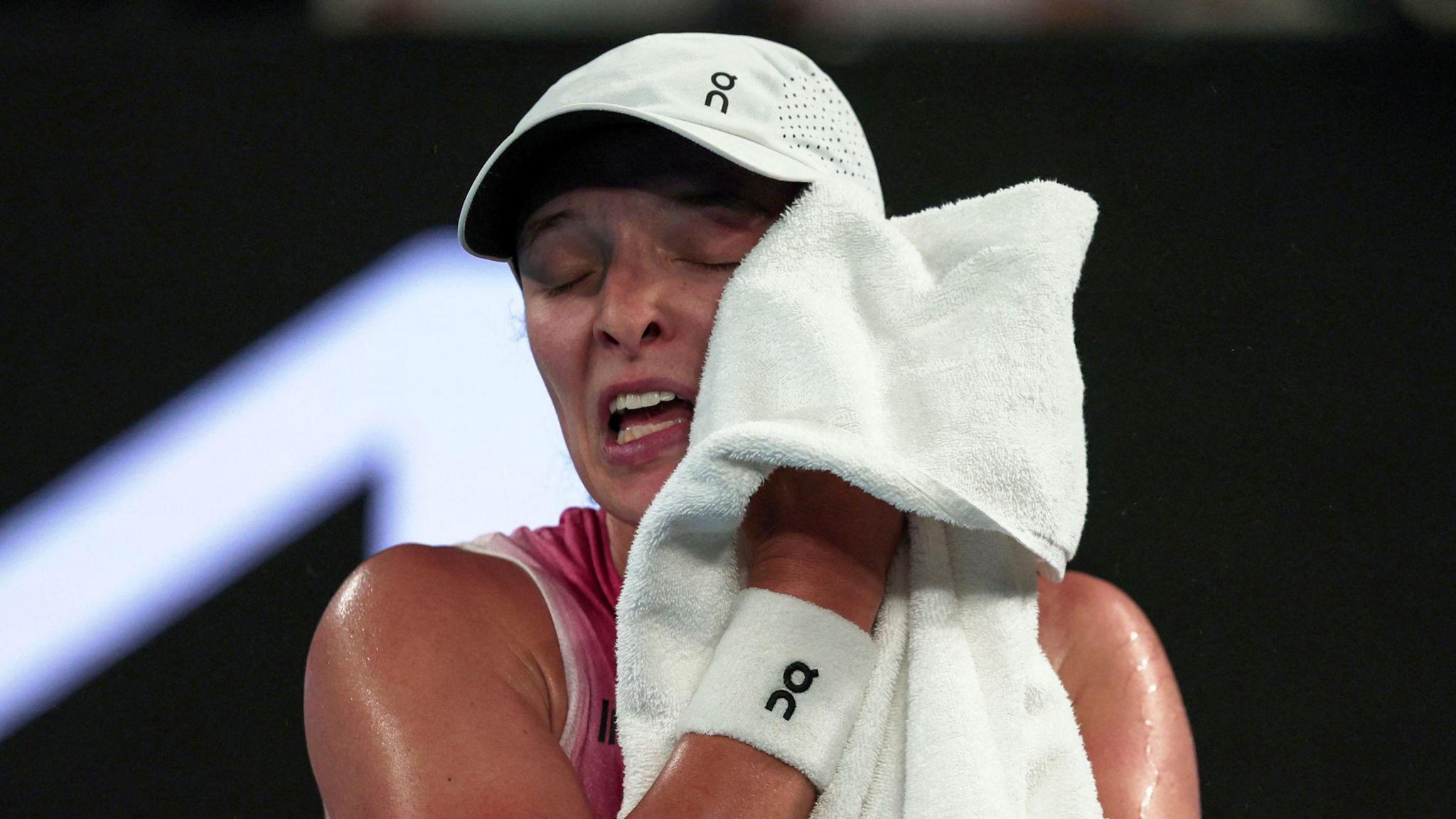
Grand Slam winner Iga Swiatek commented in September that she considers the season is "overly extended and strenuous."
At the point when Daria Kasatkina ended her 2025 season early in October, the one-time elite competitor explained how she had "hit a wall."
"The calendar is overwhelming. Mentally and emotionally I'm at breaking point, and, regrettably, I'm not alone," she stated.
Ukraine's Elina Svitolina, a double Wimbledon semi-final participant, had earlier announced she was not in "the right headspace" to continue, while sitting Grand Slam champions Iga Swiatek and Carlos Alcaraz also are convinced the calendar is excessively lengthy.
This subject remains under discussion as the world's leading tennis players assemble once more in Australia for the beginning of the 2026 season.
A marginally increased off-season than 2025 has been received well. Nonetheless, a handful of weeks is not considered enough time for proper recovery before preparations begin for an 11-month campaign considered among the most grueling in professional sport.
"The physical requirements of tennis are more intense than in the past," stated Dr. Robby Sikka, medical director at the Professional Tennis Players' Association (PTPA).
"Matches and rallies are longer, players are faster, they're hitting the ball harder.
"It is our obligation to shield the competitors and give them a more manageable sport."
So what is being done and what additional measures could be implemented?
Shortening the Season
The 2025 season spanned 47 weeks for many players on the ATP circuit, commencing with the United Cup team event in late December 2024 and ending with the Davis Cup final in late November.
The women's circuit concluded two weeks earlier when the season-ending championships concluded in early November. The International Tennis Federation moved the Billie Jean King Cup Finals forward to September to alleviate scheduling concerns.
The men's tour states it does not take the concerns of the players "without seriousness," while WTA leadership notes player welfare will "consistently be the foremost concern."
That failed to satisfy the PTPA, which commenced proceedings against the men's and women's tours in March, citing "restrictive policies and an obvious indifference to player health."
Overhauling the calendar is an clear answer but cannot be accomplished simply given the complicated structure of tennis governance, where the four Grand Slams, ATP, WTA, and ITF each have major stakes.
"It is crucial to evaluate whether we can buy back time at the end of the year for an more substantial rest period, or can we allow for a pause during the season so there is a brief respite," added Dr. Sikka.
Former world number one Andy Roddick, a long-time advocate for change, says the season should not go past 1 November.
The ATP Tour has cut the number of events which are included in the rankings for 2026, which it thinks will diminish "overall demands" on the players.
"One point that often gets overlooked: players determine their own playing calendar," commented ATP chairman Andrea Gaudenzi.
"Such autonomy is uncommon in elite athletics. But with that comes accountability - knowing when to push and when to recover."
Stretching several compulsory competitions across a fortnight - creating so-called 'extended events' - has also been faulted.
"I think players are more mentally tired and more fatigued because they're spending more days away," said Britain's former men's world number one, Andy Murray.
In addition to mental burnout, there are concerns about the increased physical demands.
Players experience a higher rate of upper-body injuries in specific periods, according to PTPA research.
The organization says these "predictable clusters" are down to the structure of the calendar and the transitions between court surfaces.
Reducing Late Finishes & Standardizing Equipment
When a high-profile game at the Australian Open finished in the wee hours in 2023, it seemed set to trigger adjustments.
In 2024, the tours brought in a new rule preventing matches commencing later than 11pm.
But there have still been instances of matches ending deep into the night - which medical experts insist.
"Once the final point is played, a player's duties continue," said Dr. Sikka.
"Media interviews, rehabilitation, and treatment are required. Your day doesn't end at midnight.
"There is insufficient opportunity for the body and mind to heal. No other major sport imposes such conditions."
Data suggests a player is significantly more prone to be injured during a late-finishing contest.
A lack of standardization in tournament equipment - leading to changes in weight and pace - has been pointed to as a source of increased upper body injuries.
"My career has been plagued by injuries to the arm and wrist," stated one top British player, "and such ailments are increasingly prevalent among peers."
A former US Open champion, who retired last year with an chronic wrist problem, believes tournaments in the same seasonal segment should use one type of ball.
"It shouldn't be too difficult - the same ball for clay, the same for hard and the same for grass. That would be incredibly useful to the players," he said.
The tours adopted a more standardized equipment policy during 2025 and expect "complete uniformity" in the coming years.
Take Lessons from the NFL & Shield Developing Athletes
Medical researchers believe tennis must emulate how American team sports use data to guide the wellbeing of its stars.
Using data-led analysis, the NFL required consistent playing surfaces and improved helmet technology to lessen the risk of injury.
"The NFL has made many rule changes based on empirical evidence," said an analytics expert whose firm provides data to monitor player welfare.
"Their commercial success has soared because their games are so competitive and they're keeping players out on the field.
"They're putting their money where their mouth is by protecting athletes and allocating major funds – that model is the benchmark."
Other leagues have implemented policies aimed at protecting throwers, limiting their workload at the professional level and putting age restrictions.
Some retired players believe the strain put on the upper body of tennis players from a tender age is a significant factor in their injuries later on.
"Training begins in childhood and have so many countless swings of our groundstrokes," said the former champion.
"At some point it goes on the wrist. Way more players have problems with the wrist. I think the problem is the many, many repetitions."
Players 'Motivated' for Change - What Do They Want?
An growing group of players are becoming vocal about the demands placed on them.
Current world number ones are among a collection of elite athletes increasing demands on the Grand Slams with calls for a bigger piece of the financial pie, as well as meaningful consultation about the tour schedule duration, extended events and scheduling.
Last year, a top-ten American player said it was "absurd" he was only able to take one week off before the next campaign.
Public understanding may be limited, though, given top players occasionally sign up for lucrative showcase matches.
One Grand Slam champion from Britain says the relentless travel is a "test" but thinks top players "moaning about the calendar" is not a good look.
"{Uniform

